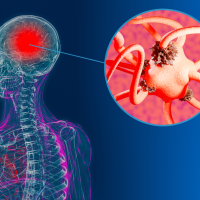
Something in the human brain can go wrong in ways that modern medicine still cannot fix. Every year, more than 14,000 Americans learn they have glioblastoma, a cancer so aggressive and so resistant to treatment that most patients survive barely more than a year after diagnosis. Surgery can remove parts of it, but the cancer weaves itself through brain tissue like roots through soil, making complete removal nearly impossible. Chemotherapy and radiation add a few extra months at best, and the toll on quality of life leads some patients to skip treatment altogether.
For decades, researchers have searched for a weakness in this cancer. Something to target that could stop tumor growth without destroying healthy tissue around it. A team at the University of Virginia may have found exactly that. And their discovery started in a place nobody expected.
What Makes Glioblastoma So Ruthless
Among brain cancers, glioblastoma occupies the worst possible category. It grows fast, spreads in ways no one can predict, and resists nearly every treatment thrown at it. Patients who receive the current standard of care, a combination of radiation and the chemotherapy drug temozolomide, gain roughly two and a half additional months of survival compared to those who receive no treatment. When that qualifies as a medical success, it says a great deal about how limited options have been.
Only about one in twenty glioblastoma patients will still be alive five years after their diagnosis. Hui Li, a researcher in the University of Virginia School of Medicine’s Department of Pathology, put it bluntly. “Glioblastoma is a devastating disease. Essentially, no effective therapy exists,” he said.
Li has spent years trying to change that equation, and his work has recently produced results that have drawn attention across the oncology world. But before his team could arrive at their latest finding, they had to follow a trail that began with an entirely different cancer.
A Clue Hidden in a Childhood Cancer

Li and his colleagues were not studying glioblastoma when they first stumbled onto the research path that would define their careers for years to come. Instead, they were investigating rhabdomyosarcoma, a rare cancer that primarily affects children. Pediatric cancers tend to involve fewer genetic mutations than adult cancers, which makes them easier to analyze at the molecular level. During that work, the team spotted something unusual in a gene called AVIL.
AVIL is not a mysterious or exotic gene. Under normal circumstances, it produces an actin-binding protein that helps cells keep their size and shape. It performs a quiet, routine function in the body’s cellular machinery. But the abnormality Li’s team observed suggested that AVIL might be doing something far more dangerous under certain conditions.
Curious whether AVIL might play a role beyond pediatric cancers, the researchers turned their attention to adult malignancies. What they found was striking. AVIL appeared to be overexpressed in every glioblastoma sample they tested, and at even higher levels in glioblastoma stem cells, the most resilient and dangerous subset of tumor cells. Yet in healthy brain tissue, the gene was barely active at all.
Li later reflected on the unexpected path that led to AVIL’s identification. Many in the field had assumed all the major oncogenes had already been found. His team’s experience suggested otherwise, and he noted that numerous cancer breakthroughs throughout history have come from studying pediatric tumors first.
Identifying Glioblastoma’s Achilles’ Heel
In 2020, Li’s team published findings in Nature Communications confirming AVIL as a bona fide oncogene in glioblastoma. A variety of factors could push the gene into overdrive, causing cancer cells to form and multiply. When researchers silenced AVIL in lab mice, glioblastoma cells were wiped out while healthy cells remained untouched.
“The novel oncogene we discovered promises to be an Achilles’ heel of glioblastoma,” Li said at the time, “with its specific targeting potentially an effective approach for the treatment of the disease.”
It was a major moment in glioblastoma research, but a large practical problem remained. Silencing a gene in a laboratory setting requires techniques that simply cannot be applied to human patients. Knowing the target was only half the battle. Li’s team now needed to find a way to block AVIL’s activity using something that could function inside a living person, ideally something simple enough to take as a pill.
Searching for the Right Molecule
What followed was a painstaking hunt through thousands of chemical compounds. Using a process called high-throughput screening, Li’s team tested large numbers of molecules at high speed to see which ones could interfere with AVIL’s function. High-throughput screening is a common approach in drug discovery, allowing researchers to evaluate potential candidates at a pace that would be impossible through traditional one-by-one testing.
From that effort, one compound stood apart. It bound directly to the AVIL protein and blocked its interaction with actin, cutting off the mechanism through which the gene drives cancer growth. On a molecular level, the inhibitor produced a gene expression profile strikingly similar to what happened when researchers silenced AVIL directly using siRNA, a strong indication that it was hitting the intended target. It also caused downregulation of FOXM1 and LIN28B, two known downstream targets of AVIL, which added further confidence that the molecule was working through the correct biological pathway.
Early Results That Surprised Even the Researchers
Published in Science Translational Medicine, the team’s latest findings describe a compound that passed its preclinical tests with encouraging results. In five separate glioblastoma mouse models, including some resistant to temozolomide, the molecule impaired tumor growth and migration while extending survival. Mice treated with the compound showed no harmful side effects.
Perhaps most importantly, the molecule affected only tumor cells. Because AVIL is barely present in healthy brain tissue, the compound left astrocytes and neural stem cells unharmed. Mice in which the AVIL gene was knocked out entirely showed no adverse health effects, suggesting that blocking AVIL carries minimal risk to normal biological functions. In a field where treatments often damage healthy tissue as much as cancerous tissue, that kind of selectivity carries enormous weight.
Crossing the Brain’s Toughest Barrier
One of the most persistent challenges in treating brain cancers has nothing to do with the cancer itself. Between the bloodstream and the brain sits the blood-brain barrier, a tightly regulated layer of cells designed to protect the brain from harmful substances. While it serves an essential protective function, it also blocks many drugs from reaching tumors inside the brain. Countless compounds have failed in brain cancer research for no other reason than their inability to cross this barrier.
Li’s molecule does not have that problem. Testing confirmed that the compound crosses the blood-brain barrier readily, meaning it can reach glioblastoma cells where they live. And because it can be delivered orally, patients would not need infusions or invasive procedures. In a future where this compound becomes an approved treatment, taking it could be as straightforward as swallowing a prescription pill each day.
A Long Road Still Ahead
For all its potential, the compound remains far from pharmacy shelves. Before it could reach patients, researchers must optimize the molecule for human use and shepherd it through the rigorous process of clinical trials. Federal Food and Drug Administration approval would follow only after extensive testing in human volunteers demonstrates both safety and effectiveness.
Li has taken steps to advance the work beyond the academic lab. He founded a company called AVIL Therapeutics to develop AVIL inhibitors, and he and colleague Zhongqiu Xie have obtained a patent related to the approach. Funding from the National Institutes of Health and the Ben and Catherine Ivy Foundation continues to support the research.
None of these steps guarantees success. Drug development is filled with compounds that showed potential in mice but failed in humans. Still, AVIL’s specificity as a target, its near-total absence in healthy brain tissue, combined with its overexpression in glioblastoma, gives researchers reason for cautious optimism.
Why Researchers See Reason for Hope
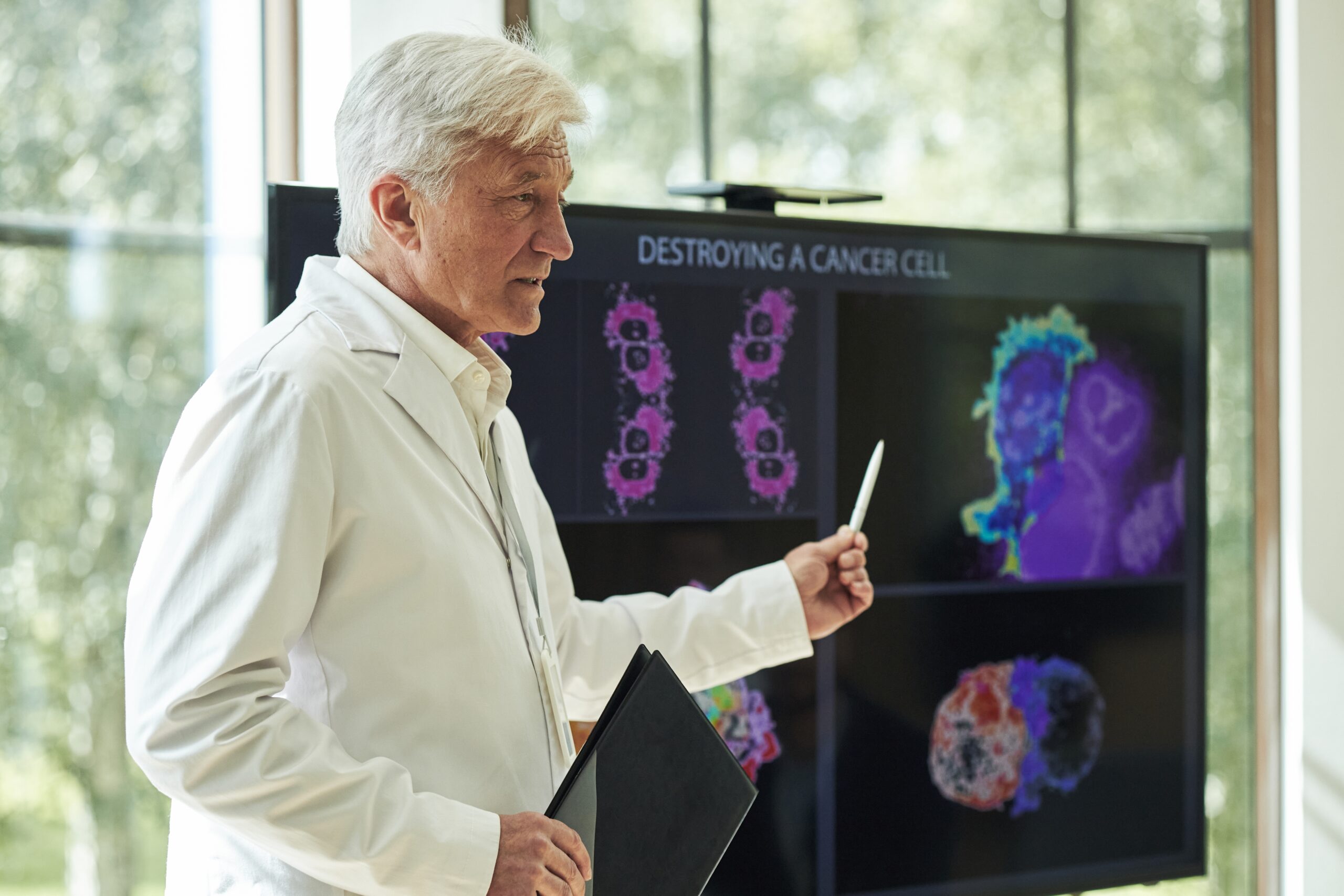
What sets Li’s work apart from many previous glioblastoma efforts is that it targets a biological mechanism no one has pursued in treatment before. Rather than trying to improve upon existing chemotherapy or radiation protocols, Li’s approach goes after a protein that glioblastoma cells depend on for survival in ways healthy cells do not. His team believes this represents an entirely new mechanism of action, one that could change how the medical community thinks about treating the disease. “GBM patients desperately need better options. Standard therapy hasn’t fundamentally changed in decades, and survival remains dismal,” Li said.
Li’s team also believes their research strategy, tracing genetic abnormalities from pediatric cancers back to adult ones, could open doors for other types of cancer. AVIL’s identification shows that the oncogene map may not be as complete as many assumed, and the method that led to its discovery could be repeated across other malignancies where treatment options remain inadequate.
For the more than 14,000 Americans who will hear the word “glioblastoma” from their doctors in the coming year, any new direction in research represents something that has been in short supply for a long time. Whether Li’s compound becomes the treatment that finally changes outcomes for glioblastoma patients remains to be seen. But the science behind it represents the most targeted approach researchers have attempted against a cancer that, until now, has had no real answer.