
In recent years, the once-humble car headlight has undergone a technological evolution. From halogen bulbs to high-intensity discharge (HID) and now to light-emitting diode (LED) systems, headlights today are brighter, whiter, and more efficient than ever. But for a growing number of drivers, this leap in technology has created a significant—and sometimes dangerous—side effect: glare.
A major new survey by the RAC sheds light on just how widespread and disruptive the issue has become. Drivers across the UK are speaking out about the effects of increasingly intense headlights on their comfort, safety, and behavior behind the wheel. For some, it’s a matter of mild discomfort. For others, it’s changing how, and even if, they drive at night.
Almost All Drivers Affected
The study reveals that virtually all drivers (97%) say they experience headlight glare to some degree. Of those, nearly 36% believe most headlights are too bright, while 59% say some are too bright. These aren’t just older drivers either; those under 35 were more likely than average to say that most vehicle headlights are excessively bright (41%).
This suggests the issue isn’t rooted solely in age-related vision decline, but rather in how lighting technology is impacting drivers across demographics and vehicle types. And while younger drivers may have quicker visual recovery times, they are not immune to the distracting or even disorienting impact of intense LED beams, particularly on dark, rural roads.
More Than Just Annoying: A Safety Hazard
Among drivers who report experiencing glare:
- 59% say it makes driving uncomfortable or difficult
- 53% report being temporarily blinded while driving
- 41% say they feel less safe
- 31% feel less confident behind the wheel
Temporary blindness caused by headlight glare can create split-second lapses in attention—enough to miss a pedestrian, misjudge a turn, or fail to respond to an obstacle in the road. While official road safety data links an average of 280 collisions per year in the UK to dazzling headlights, with six fatalities annually, experts believe the real impact could be much higher, as glare is rarely noted as a cause unless specifically mentioned by attending officers.
Driving Behavior Is Changing
A growing number of motorists are adjusting their habits to cope with the effects of glare:
- 25% say they are now driving less at night
- 22% say they would like to reduce nighttime driving but can’t
- 5% have stopped driving at night altogether
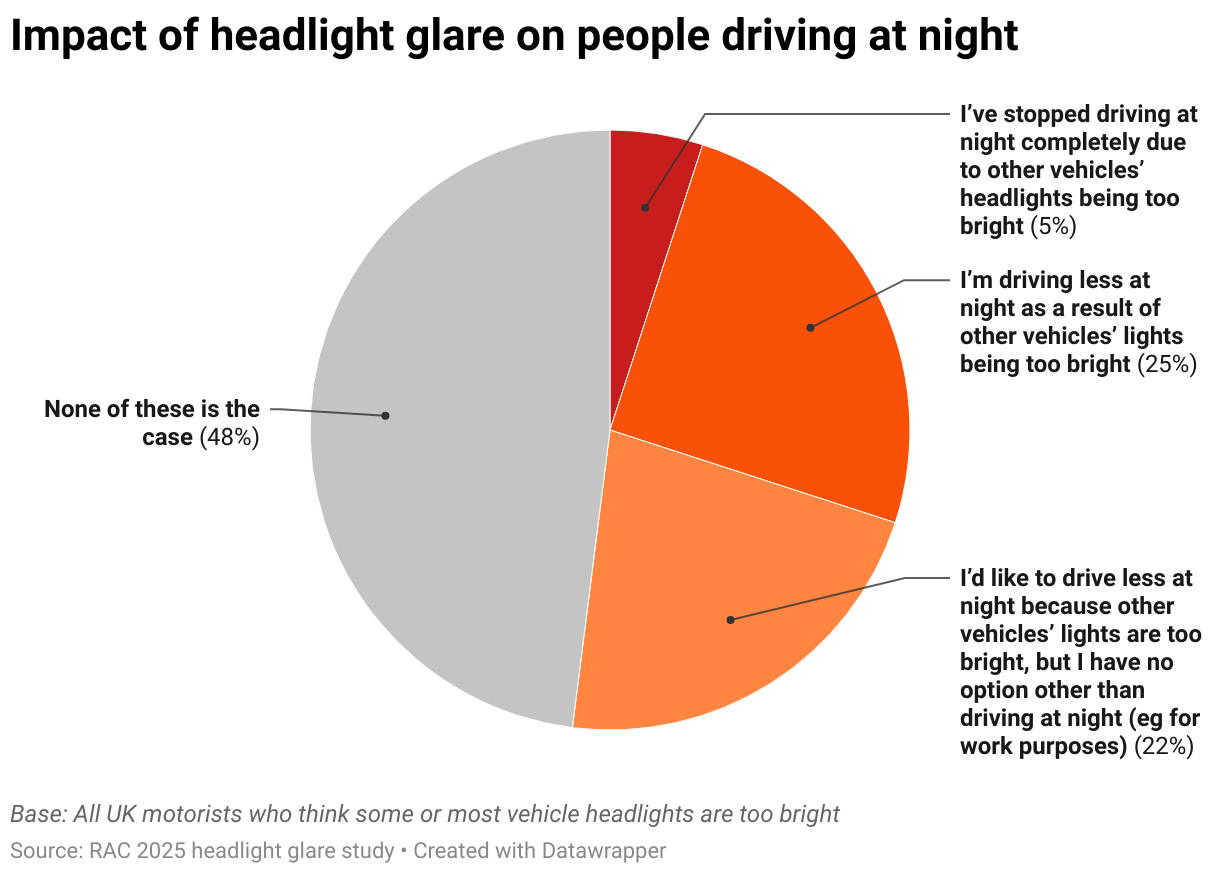
These behavioral shifts are not without consequence. Reduced nighttime mobility can affect everything from employment to social participation, especially for those in rural areas or with irregular working hours. For older drivers, glare can compound existing anxieties around night driving, potentially accelerating the decision to give up driving entirely, raising concerns about social isolation and reduced independence.
Physical Side Effects and Health Risks
Some motorists report even more serious physical symptoms:
- 17% feel fatigued or tired due to bright headlights
- 10% suffer eye pain during or after driving
- 9% report headaches
- 4% say bright lights cause migraines
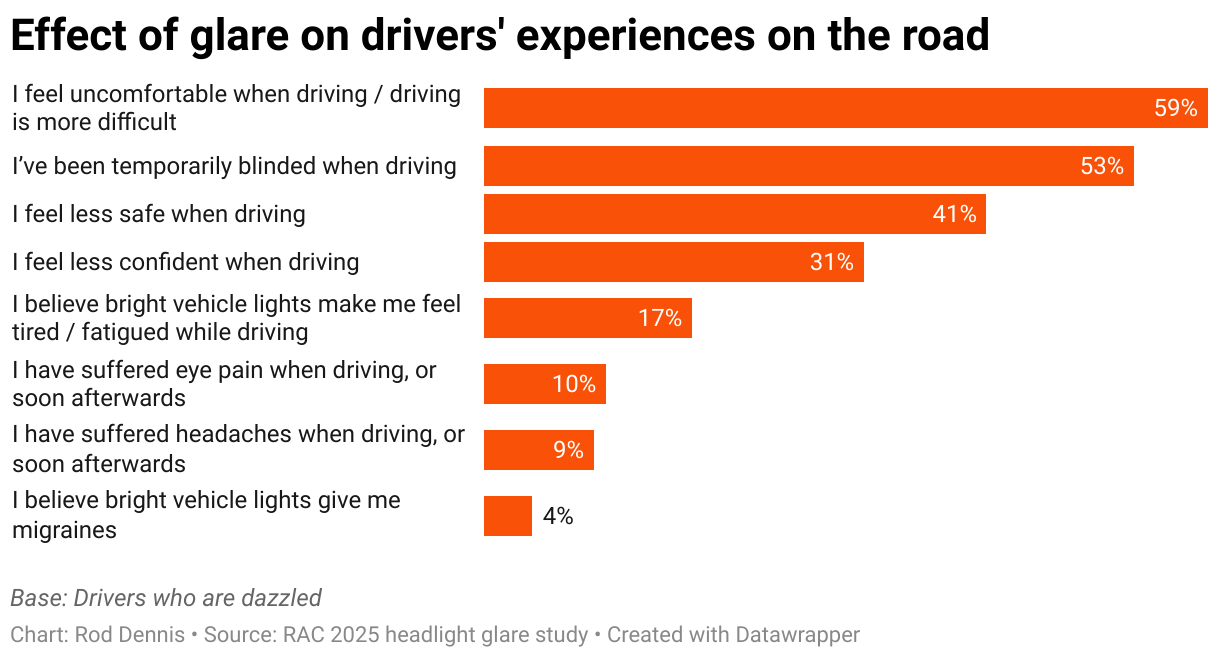
These symptoms point to a physiological response beyond momentary distraction. Fatigue and eye strain from intense contrast in lighting can diminish reaction time and judgment, especially over long journeys. Optometrists are increasingly hearing complaints from patients well before typical age-related conditions like cataracts set in, indicating the issue is affecting a broader range of people than previously assumed.
Why Is Glare So Bad Now?
The RAC study points to a combination of factors:
- Headlight alignment: Misaligned beams or aftermarket installations may be improperly aimed.
- Vehicle height differences: Drivers in lower vehicles like hatchbacks are more likely (56%) to blame higher vehicles like SUVs for glare.
- Color temperature: Whiter headlights—mostly LEDs and bi-xenon—are more likely to cause discomfort. 72% of those affected say white-colored headlights are to blame, compared to just 3% who point to yellow ones.
Headlight glare is especially problematic on unlit roads, where the contrast between bright beams and complete darkness can be jarring. Unlike urban environments, rural roads offer no ambient lighting to balance out oncoming beams, making it harder for eyes to adapt. The problem is amplified by newer, taller vehicles that sit higher on the road, often directing light beams straight into the eyes of drivers in standard cars.
Interestingly, drivers of higher-riding vehicles were more likely to believe no single vehicle type was responsible for glare (65%), possibly because they are less affected by lights coming from above their line of sight. This perception gap suggests that those driving SUVs and trucks may not be aware of the discomfort their headlights are causing for others.
What Drivers Can Do to Reduce Glare
If you find yourself frequently dazzled by headlights at night, there are a few practical steps shared by RAC that you can take:
- Talk to your optician: Only 8% of survey respondents had done this, but it can help. For glasses wearers, anti-glare lens coatings can significantly reduce headlight reflections. About 22% of drivers say they already use such glasses.
- Adjust your rear-view mirror: Many modern cars come with auto-dimming mirrors, but if yours doesn’t, make sure to flip it to night mode when driving in the dark. Among glare sufferers, 57% say they regularly adjust their mirrors to reduce glare from vehicles behind them.
- Consider glare-reducing features when buying your next car: Features like self-dimming mirrors and tinted rear windows (sometimes called ‘sunset glass’) can reduce how much light reaches your eyes, especially from trailing vehicles.
Are You the One Dazzling Others?
Most drivers don’t intend to blind others with their headlights, but it can happen without you realizing it. Unlike speeding or texting behind the wheel, glare isn’t always something you feel directly responsible for. Still, if your lights are poorly aimed or too intense, they could be creating serious problems for other road users.
So how can you tell if your headlights are a nuisance—or worse, a hazard—for others?
- Pay attention to how other drivers react: If you frequently get flashed by oncoming traffic or notice drivers adjusting their mirrors as you approach, it may be a sign your lights are too bright or misaligned.
- Understand the impact of vehicle load: A fully loaded car—passengers, cargo, or even just a heavy trunk—can tilt your vehicle enough to send your headlights pointing higher than intended. Many vehicles come with manual leveling switches; if yours does, consult the manual and adjust accordingly before long night drives.
- Have your headlight alignment checked: Headlight misalignment is more common than most people think, especially in vehicles with aftermarket lighting. A quick visit to a trusted mechanic or inspection center can ensure your beams are aimed properly and aren’t contributing to road glare.
- Avoid DIY adjustments unless you’re trained: Misadjusting bulbs without the right tools or knowledge can do more harm than good. Leave the beam alignment to professionals. In fact, improper aim is a top reason for headlight-related inspection failures.
- Upgrade wisely: If you’re considering installing LED or HID headlights, make sure they’re compliant with federal and state regulations. Stick to DOT-approved models and avoid budget kits that lack proper beam cutoff features.
- Check for foggy or dirty headlight lenses: Dull or yellowed lenses can scatter light in unintended directions. Cleaning or restoring your headlight covers can improve focus and reduce stray glare.
- Consider switching to adaptive or self-leveling systems: If your vehicle supports it or you’re shopping for a new car, look for models with these safety-focused features. While more common in premium models, they’re slowly becoming accessible in mid-range cars as well.
Being a responsible driver isn’t just about watching your speed or staying in your lane—it’s also about making sure your lights help you see without compromising the safety of others.
The Road Ahead: Regulation and Action
In the United States, headlight glare has yet to receive the same level of regulatory attention as other road safety issues like distracted driving or impaired driving—but growing public concern may change that.
Currently, the Federal Motor Vehicle Safety Standards (FMVSS) regulate allowable headlight brightness and beam patterns. However, critics argue that the standards haven’t kept pace with advancements in lighting technology like LEDs and adaptive systems. The National Highway Traffic Safety Administration (NHTSA) has acknowledged the need for updated guidelines, especially as more vehicles are outfitted with high-mounted headlights and retrofitted LED kits.
Adaptive beam technology, which automatically adjusts brightness to avoid blinding other drivers, has been allowed on U.S. roads since a rule change in 2022. While this marked a positive step, adoption has been slow and remains largely limited to newer, high-end vehicles.
Advocates for safer lighting call for:
- Modernizing headlight testing and approval standards to include real-world driving scenarios and glare impact on other road users
- Improved enforcement of aftermarket modifications that exceed legal brightness or are improperly installed
- Public education campaigns to help drivers identify and correct headlight misalignment
- Incentives or mandates for manufacturers to include glare-reducing features, like adaptive beams and auto-leveling systems, across more vehicle models—not just luxury tiers
At the state level, some jurisdictions are considering legislation that would require regular headlight inspections as part of vehicle safety checks. Until clearer regulations are in place nationwide, responsibility largely falls on individual drivers and vehicle owners to ensure their headlights are safe—not just bright.
Final Thoughts
As more people opt for taller vehicles with brighter beams, and lighting technology continues to evolve, public policy, car manufacturers, and regulators must move just as quickly to ensure safety and comfort for everyone on the road.
What began as a technological improvement is now inadvertently undermining public confidence in night driving. Whether through design flaws, poor installation, or lack of oversight, the unintended consequences of modern headlights are being felt by nearly every motorist.
It’s time for industry and government to act—and for drivers to be part of the solution. Because for many, it’s not just about seeing better. It’s about feeling safe enough to drive at all.
This article is co-published with Social Sweethearts GmbH